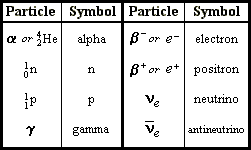
Symbols for Chemistry and Physics

You can use these symbols in your questions or assignments.

ReferenceInstructor HelpWebAssign

Chemistry and Physics

Symbol

Code

A B with arrow

s:abarrow

A B bar

s:abline

A wave enclosed with a circle represents an AC source.

s:acsource

alpha particle

s:alphaparticle

aromatic bond

s:aromaticbond

aromatic bond

s:aromaticbondshort

C B with arrow

s:cbarrow

C E with arrow

s:cearrow

reaction arrow identifying cold conditions

s:coldrtarrow

D A with arrow

s:daarrow

D C with arrow

s:dcarrow

D E with arrow

s:dearrow

reaction arrow identifying the need for a direct electric current

s:decrtarrow

double bond

s:doublebond

E A with arrow

s:eaarrow

E B with arrow

s:ebarrow

reaction arrow identifying the need for electrical energy

s:eertarrow

superscript 0 subscript -1 e

s:electron

e m f

s:emf

e m f

s:emf2

e m f bar

s:emfbar

energy increases along the vertical axis

s:energyarrowlong

energy increases along the vertical axis

s:energyarrowshort

energy increases along the vertical axis

s:energyarrowsmall

reaction arrow in the presence of water

s:H2Ortarrow

s:hbar

h bar

s:hbarsm

Planck constant

s:hbarred

Curved loops represent inductance.

s:inductor

s:lewisdot

m sub l

s:ml

superscipt 1 subscript 0 n

s:neutron

summary of nuclear particles; consult your textbook for relevant examples

s:nuclearparticles

length of vector O A

s:oaline

down orbital

s:orb_d

empty orbital

s:orb_e

diagram for an unoccupied orbital state

s:orb_none

up orbital

s:orb_u

up down orbital

s:orb_ud

superscipt 0 subscript +1 e

s:positron

superscript 1 subscript 1 p

s:proton

reaction arrow identifying a Pt/Rh catalyst

s:ptrtarrow

non-equilibrium reaction arrow

s:revrxarrow_cancel

equilibrium reaction arrow

s:revrxarrow

equilibrium reaction arrow favoring the product side

s:revrxarrow1

s:revrxarrow2

equilibrium reaction arrow identifying the presence of water

s:revrxarrowH20

equilibrium reaction arrow identifying the requirement for light

s:revrxarrowhv

equilibrium reaction arrow

s:revrxarrowred

equilibrium reaction arrow with rate constants k subscript +1 and k subscript -1

s:revrxnarrowk

equilibrium reaction arrow governed by the constant K subscript CO

s:revrxnarrowkco

equilibrium reaction arrow governed by the constant K subscript O subscript 2

s:revrxnarrowko2

equilibrium reaction arrow with rate constants k subscript +1 and k subscript -1

s:revrxnk1

equilibrium reaction arrow with rate constants k subscript +2 and k subscript -2

s:revrxnk2

equilibrium reaction arrow with rate constants k subscript f and k subscript r

s:revrxnkf

reaction arrow identifying the presence of an acid catalyst

s:rtarrowac

reaction arrow identifying the presence of an acid

s:rtarrowAcid

reaction arrow identifying acidic conditions

s:rtarrowAcidic

reaction arrow identifying acidic conditions

s:rtarrowacidic

alpha over a right arrow

s:rtarrowalpha

reaction arrow identifying the presence of bacteria

s:rtarrowBacteria

reaction arrow identifying the presence of a base

s:rtarrowBase

reaction arrow identifying basic conditions

s:rtarrowBasic

beta over a right arrow

s:rtarrowbeta

reaction arrow identifying the presence of a catalyst

s:rtarrowcatalyst

reaction arrow identifying a Cl catalyst

s:rtarrowClcat

reaction arrow with heat added

s:rtarrowDelta

E with arrow

s:rtarrowE

reaction arrow identifying the need for an electric current

s:rtarrowEc

reaction arrow identifying the need for electricity

s:rtarrowelec

reaction arrow identifying the occurrence of electron capture

s:rtarrowelecap

reaction arrow identifying electrolysis conditions

s:rtarrowelect

F with arrow

s:rtarrowF

reaction arrow identifying the presence of water

s:rtarrowH20

reaction arrow identifying the presence of heat

s:rtarrowHeat

reaction arrow identifying the need for heat and pressure to be applied

s:rtarrowheatpressure

reaction arrow identifying the presence of hexane

s:rtarrowhex

reaction arrow identifying the presence of hot CuO(s)

s:rtarrowhotCuOs

reaction arrow identifying the need for radiant energy identified as h nu

s:rtarrowhv

reaction arrow with rate constant k

s:rtarrowk

reaction arrow identifying the rate constant k subscript 1

s:rtarrowk1

reaction arrow identifying the rate constant k subscript 2

s:rtarrowk2

reaction arrow identifying the rate constant k subscript 3

s:rtarrowk3

reaction arrow identifying the rate constant k subscript 4

s:rtarrowk4

L with arrow

s:rtarrowL

reaction arrow identifying the need for light

s:rtarrowlight

reaction arrow identifying an NO catalyst

s:rtarrowNOcat

reaction arrow identifying the presence of an oxidant [Ox]

s:rtarrowox

p with arrow

s:rtarrowp

reaction arrow identifying the presence of Pt

s:rtarrowPt

reaction arrow indicating that the reaction proceeds in the presence of Pt and at 825 degrees C

s:rtarrowpt825

reaction arrow identifying the need for radiant energy

s:rtarrowradeng

sf transform arrow

s:rtarrowsf

reaction arrow identifying the presence of yeast

s:rtarrowyeast

single bond

s:singlebond

triple bond

s:triplebond

wedge arrowhead pointing up

s:wedgearrow